
Most agency owners do not stall on the decision to insurance outsource. They stall on how to begin without disrupting the book they have spent years building. What unsticks them is realizing the first move can stay small and reversible, and be measured as it goes, so it never feels like a bet on the whole agency. Here is the path assuretrac walks new agencies through, so your first insurance outsource decision is one you can stand behind.
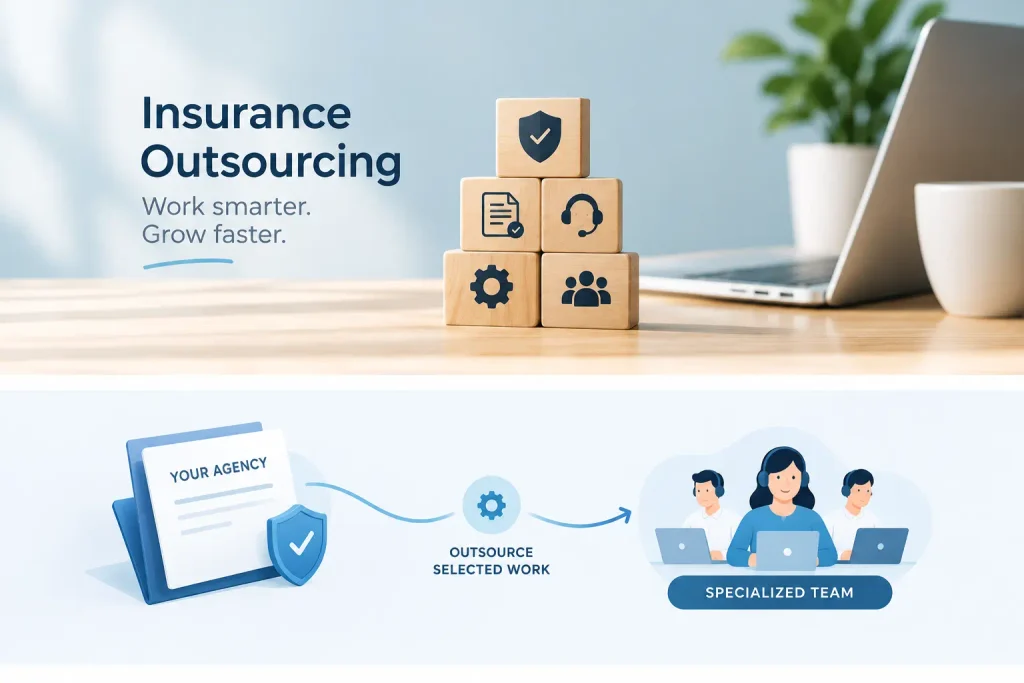
The whole idea of insurance outsourcing is to move defined, repeatable work to a specialized team while your book, your carrier appointments, and every licensed decision stay with you. Start there and the rest of the sequence follows naturally.
Table of Contents
What does “Insurance Outsource” actually mean?
Outsourcing is when you pay another company to do some of your day-to-day jobs instead of hiring more people in your company․ An insurance outsource arrangement simply moves selected operational work to that outside team․
The outside team can also input information‚ change the policies‚ handle certificates and the renewals‚ or provide phone support․
This is where an Insurance Outsource provider can take repetitive work off your internal team’s queue․
One thing does not change. You still stay responsible. If your regulator finds a problem, you cannot say “our vendor did it.” The work moves. The responsibility stays with you. That principle should remain central to any insurance outsource decision․
What does an Insurance Outsource really cost?
- The invoice is not the full cost. There are four parts.
- The vendor’s fee. Charged per person, per task, or per result.
- Setup cost. Writing down your process, training, and running both teams in parallel for a while.
- Management cost. Someone on your side must check quality and hold monthly reviews.
- Technology cost. System logins, secure access, and monitoring.
- Most business cases only count part 1. Then people feel cheated after six months.
Also, be careful with the savings numbers vendors publish. Some say 15–20%. Some say up to 50%. None of them explain how they measured it. Do not build your plan on those figures. Use your own numbers instead: what does one policy change cost you today, and how long does it take?
What can go wrong when you outsource insurance work?
Five problems cause almost every failure. These are risks any insurance outsource buyer should test for before signing․
Quality drops quietly. The first three months are great. Then the good staff move to another client and nobody tells you. Ask for turnover on your account every month, not company-wide.
No one owns it on your side. Monthly review gets skipped. Then skipped again. Six months later quality is bad and nobody noticed.
Data risk. More people can now see customer information. Under the NAIC Insurance Data Security Model Law, licensees must run a written security programme and must also check and control their outside service providers. Not every state has adopted this law, so confirm what applies to you.
Knowledge leaves your building. If only the vendor understands the process, you lose all bargaining power at renewal.
Wrong level, too early. Giving real authority to a partner you have not tested is the fastest way to a bad year. Keep your first insurance outsource engagement narrow and measurable․
What are the steps to start an insurance outsource plan?
The path runs in five steps: figure out where your hours go, check your readiness, choose a pricing model, run a small pilot, then scale and plan the exit. None asks you to bet the agency, and each lets you learn something before the next.
Step one: figure out where your hours actually go
Look at where the week disappears. In one recent agency survey, staff reported spending 60 to 70 percent of their time on admin rather than clients. List the tasks that slow your people down and touch no licensed judgment: certificates, endorsements, renewal prep, data entry. That list is your starting scope.
The tasks to move first are the ones you can measure. Outsourcing insurance work that you can track on turnaround and accuracy lets you hand it off with confidence and watch it closely. Anything fuzzy or relationship-driven waits.
Step two: check your agency’s readiness
Outsourcing is a change your whole team lives with, well past the day the contract gets signed. Get your in-house staff on board early, because a transition they quietly resent will struggle no matter how strong the partner. Decide who owns the relationship, set clear objectives, and agree on success metrics before anyone starts.
This is also the moment to be honest about scale. Insurance industry outsourcing ranges from a few part-time hours to full carrier-scale programs, and a small agency does not need to commit to a full-time resource to begin. Right-sizing the first step keeps it low-risk.
Step three: choose the right Assuretrac model
Pricing runs on three models: per-transaction, a dedicated team at a monthly rate, or outcome-based against SLAs. For cyclical agency work, dedicated or outcome-based usually beats per-transaction, which spikes exactly when a storm triples your volume. Assuretrac matches the model to your actual volume pattern, not to whatever a vendor finds easiest to sell you.
Whatever you decide, the reason to outsource insurance work with a specialist rather than a generalist BPO is simple: a team that lives in insurance all day handles a misread endorsement or an odd carrier form without breaking stride.
Step four: run a small pilot
Never flip a switch across the whole operation. Start with one documented, low-risk process and run it as a pilot against the SLAs and accuracy targets you set in step two. Assuretrac stands up live dashboards on volume, turnaround, and error rates in the first week, so the pilot proves itself on numbers instead of promises. If it works, you have earned the next step. If it does not, you found out for almost nothing.
Done this way, the move to insurance outsource becomes a sequence of small, evidence-backed steps you control, which is the point of outsourcing in the insurance industry done well.
Step five: scale, review, and plan the exit
Once the pilot earns your trust, roll the model out to more tasks and keep a regular review rhythm with your partner to catch issues early. Settle the exit terms up front too, how your data, documentation, and process knowledge come back to you, so you stay in control. You will probably never invoke that clause, but you will be glad it is there if you do.

How do you check an Insurance Outsource partner before you sign?
Ask for proof, not promises. Here is a short list. A good insurance outsource partner should be able to show evidence for each point․ Before signing, it can also help to compare established insurance outsourcing companies against your requirements rather than relying only on a vendor’s sales pitch.
- Real insurance experience. “We do insurance” is weak. “We process commercial endorsements in Applied Epic daily” is strong.
- A security report (SOC 2 Type II) that actually covers the office where your work will be done.
- Financial statements. A weak vendor cuts your team first.
- Licence check if any authority is being given.
- A written quality method — how many files they check, how errors are counted, and who fixes them.
- Turnover numbers on your account, in writing.
- Exit terms. Notice period, data return, and handover help. Agree this while everyone is happy. You cannot negotiate it later.
Ready to test an Insurance Outsource model?
Talk to our insurance outsourcing team about your current workload, the processes that are creating bottlenecks, and where a controlled 90-day pilot could reduce pressure without giving up operational control.
Request a Free Insurance Outsourcing Consultation →
Frequently Asked Questions
What is the first step to insurance outsource work?
Audit where your team’s hours go and list the repetitive, unlicensed tasks that slow them down: certificates, endorsements, renewal prep, data entry. That list becomes your first scope, and the tasks you can measure are the ones to move first.
How do I know my agency is ready to insurance outsource?
You are ready when your in-house team is on board, you have named someone to own the partnership, and you have agreed on success metrics before go-live. The buy-in matters as much as the budget here, and owners underrate it.
Should I outsource everything at once?
No. Start with one documented, low-risk process as a pilot, measure it against clear SLAs, and widen only once it proves out. A phased approach reduces risk and builds confidence on both sides.
How long before an insurance outsource pilot shows results?
An agency servicing pilot can reach steady state in a week or two, with live reporting from the first week. That early visibility is what tells you whether to scale or adjust.
Is it safe to insurance outsource client-related work?
Yes, when controls are real. Ask for SOC 2 evidence, a signed NDA and data processing agreement, role-based access, no local storage, and a named access list, then keep annual audit rights in the contract.
What should never be part of an insurance outsource scope?
Licensed decisions and relationship-driven moments: binding, advising on coverage, negotiating with underwriters, and sensitive client or claim conversations. Those stay with your licensed staff.
How do I measure whether the insurance outsource arrangement is working?
Track turnaround by task type, error and rework rate, producer hours returned each week, and retention on the renewals the team handled. Record the baseline before go-live, because you cannot rebuild it afterward.