
Insurance BPO Providers: 2026 Guide to Selection, Implementation & ROI
Insurance Virtual Assistant
Insurance agencies and carriers constantly seek to lower their overheads while maintaining legal requirements and high levels of service. Insurance business process outsourcing provides an answer: Leading organizations report labor cost reductions of 40–70%, renewal cycle time improvements of up to 30%, and compliance error reductions of up to 60%, according to industry benchmarks. It’s difficult to find an insurance BPO provider who will implement correctly, be transparent in pricing, and measure the ROI, but the best insurance BPO providers make it possible.
Funneled through market research, competitive readiness, and real-world business processes, this guide helps insurance industry decision-makers understand the options available when choosing an insurance BPO provider, including vendors, pricing, vendor risk, and implementation strategies that lead to concrete business outcomes.
Table of Contents
What Insurance BPO Is—and Why It Matters in 2026

Insurance BPO is the outsourcing of repetitive, transaction-oriented insurance processes to third parties, allowing organizations to focus on client service, underwriting, and business growth. This is a core part of insurance industry outsourcing. Services provided by an insurance BPO provider can include policy administration (renewals, endorsements, and COI issuance), claims support, underwriting support, communications with carriers, and data content quality services. According to Mordor Intelligence, the global insurance BPO market was valued at approximately USD 64.31 billion in 2025 and is projected to reach USD 89.33 billion by 2030 at a CAGR of 6.79%. The three factors are:
- Cost Pressures: Industry analysis, including research attributed to McKinsey, suggests outsourcing can reduce operational costs by 15–25%, with offshore labor savings reaching up to 70%.
- If transformation accelerates digitally, then RPA and AI can automate between 50% and 80% of repetitive policy administration and claims tasks, depending on workflow complexity and system readiness. Capgemini research indicates that platform integrations can reduce claims processing times by up to 30%.
- GDPR, HIPAA, SOX and state regulations all require in-house audits because compliance requirements increased. Under GDPR, fines can reach up to €20 million or 4% of global annual turnover — whichever is greater— making outsourced compliance management an increasingly critical business decision.
Service Models Compared: When Each Model Wins
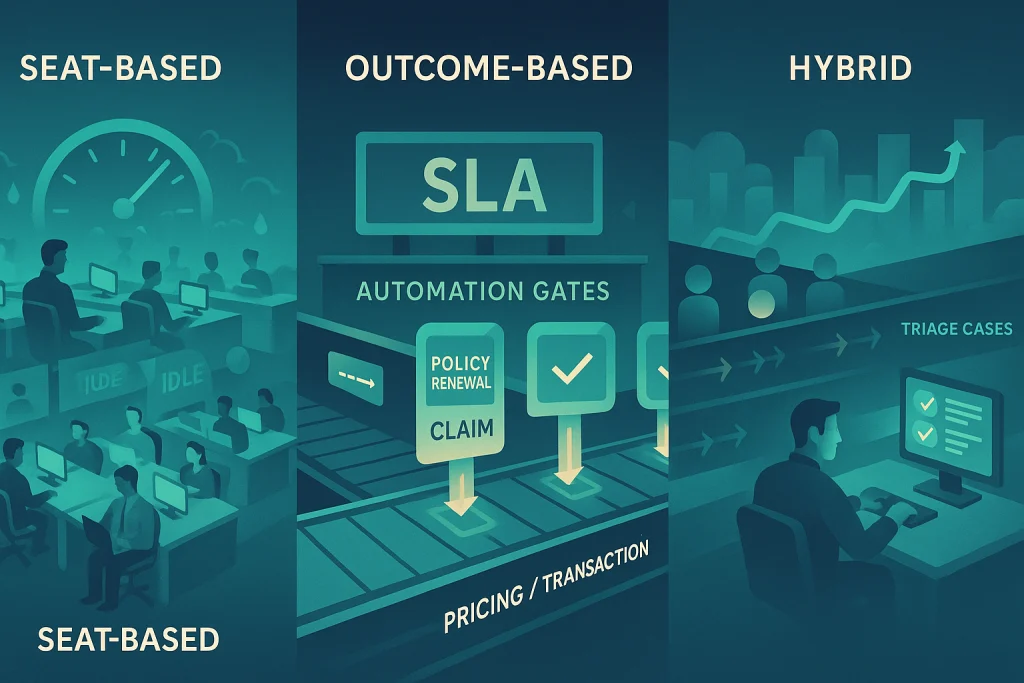
Seat-Based (Offshore Staffing) Model
How it works: Your insurance BPO provider staffs full-time or part-time employees for your account. You pay per seat per month, regardless of usage.
Pros:
- Transparent headcount
- Flexible team scaling
- Direct management
Cons:
- Idle capacity charges
- Client pays for attrition and training costs
- Limited automation (manual processes)
- BPO staffing hubs in parts of Asia can experience annual attrition rates of 20–35%, creating continuity risk for agencies relying on seat-based models.
- Best for organizations with a fairly predictable volume of work and internal project management
Outcome-Based (Process Automation) Model
How it works: The insurance BPO provider handles policy renewals, claims, or data entry and charges a transaction fee or results-based compensation that scales with business volume.
Pros:
- No idle capacity waste (pay only for work done)
- Provider incentivizes automation/efficiency (they absorb optimization costs)
- Direct system integration (e.g., AMS360 or Epic)
- SLA-driven accountability
Cons:
- Higher per-unit costs for mature processes
- Less direct workforce control
- Requires clean data and strict workflows
- Best for organizations willing to take accountability for outcomes, standardize processes, and work with a provider focused on automation. At the same time, insurance virtual assistant services like Assuretrac come equipped with strong accountability, automation, and insurance platform expertise
Hybrid Managed Services Model
How it works: Provider combines dedicated team members (for exceptions) with automation (for high-volume routine work).
Pros:
- Balances control with a mix of team and automation.
- Handles both standard and exception workflows.
- Offers flexibility to adjust as processes evolve.
Cons:
- Most complex to contract and manage.
- Can be more expensive than pure staffing or automation.
Best for: Enterprises with multi-line insurance and varying levels of workflow maturity.
High-Value Insurance Workflows Your Outsourcing Partner Must Handle
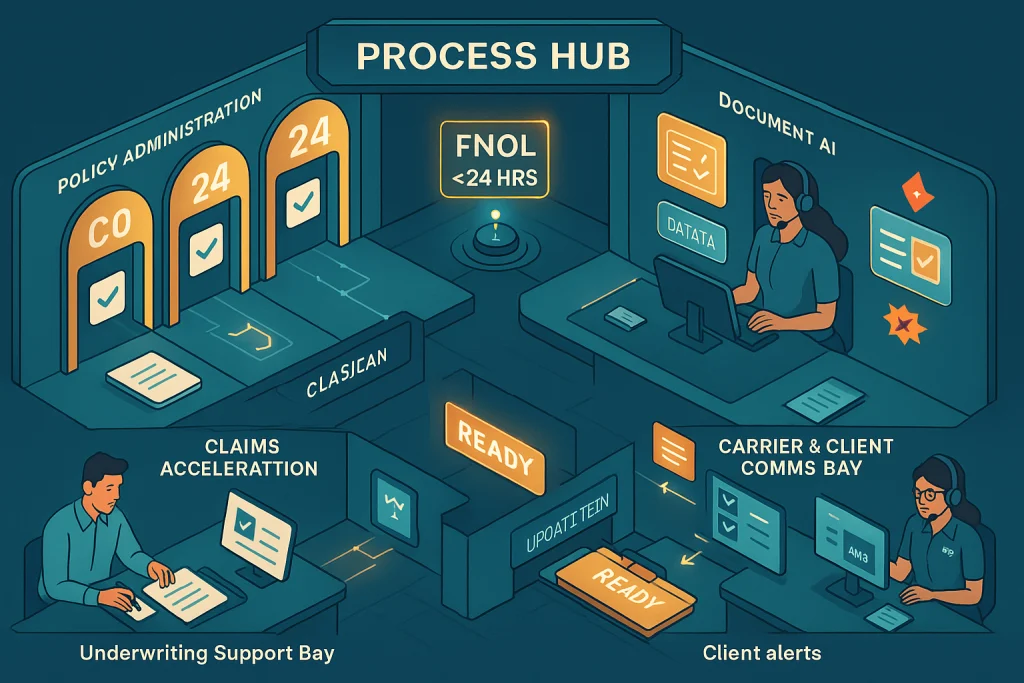
Policy Administration: Renewals, Endorsements, Audits, Proof of Insurance
Policy admin centers on renewals that retain clients, endorsements that comply with regulations, and COIs that affect client satisfaction and costs. Agencies handling over 50 renewals a week often face timeliness and accuracy issues.
How it’s done: A strong insurance BPO provider will ensure their VAs use AMS360 and/or Applied Epic integrations inside a platform like Assuretrac to set due dates, write notes, engage with carriers, issue COIs, and track endorsement requests. Agencies have reported a 25% improvement in their ratios thanks to a more structured approach to renewals and solid insurance back office support.
Claims Acceleration: FNOL, Triage, Fraud Flags, Subrogation Support.
In-house FNOL processing can take 3+ days. Document AI and smart triage can cut this to under 24 hours. Fraud detection AI detects questionable claims.
How an insurance BPO provider accelerates this: An insurance virtual assistant extracts key information from claim forms, loss descriptions, and policies. The virtual assistant validates data, flags outlier situations, and routes them to adjusters. Agencies using AI-assisted FNOL processing report up to 40% faster intake times and measurable improvements in fraud flag accuracy, though results vary by implementation.
Underwriting Support: Submissions Prep, Data Enrichment, Rating Inputs.
Underwriters spend 20-30% of their time collecting information, loss runs, and documents that they would rather spend on evaluating risk.
How an insurance virtual assistant does this: Outsourced teams from an insurance BPO provider collect loss runs, prior coverage summaries, and policy information. Virtual assistants create organized submission packages with attachments, standard templates, and checklists. Underwriters receive submission-ready packages, which cuts review time by 30 to 40%.
Carrier Updates & Client Communication Management
Agencies also handle carrier notifications, rate changes, forms and customer notifications. Missing deadlines may result in non-compliance or lack of service.
An insurance virtual assistants from an insurance BPO provider can add value by reviewing a portal such as Assuretrac, reading carrier bulletins, identifying and updating policy changes, updating AMS systems and notifying the agent on the client’s situation.
How to Choose an Insurance BPO Provider: 6 Essential Criteria

Criterion 1: Insurance Industry Specialization
What matters: Whether the vendor has deep, documented expertise in insurance back office outsourcing, or is a generalist business process outsourcer. Insurance outsourcing vendors with a specialty are often a better choice.
Red flags:
- Generic service descriptions
- Limited insurance case studies; focus on other industries
- No documented understanding of AMS360, Applied Epic, etc.
Green flags:
- Published case studies on policy administration, claims, or underwriting
- Certified in insurance compliance (GLBA, NAIC, HIPAA)
- Direct integrations with major insurance software
- 5+ years of insurance underwriting experience
How Assuretrac shows specialization: Assuretrac publishes AMS-specific support lists (Applied Epic, AMS360, etc.), documents the workflows for communicating with carriers, and shares case studies on significant improvement in renewal ratio and substantial reduction in E&O errors.
Criterion 2: Technology Stack & System Integration
What matters: Can the vendor integrate with your systems like AMS or accounting, or will the vendor require manual data entry into your systems? Do BPO providers help with digital transformation? Yes, the best ones do.
Questions to ask:
- Do you provide native API integration to [your AMS]?
- Can your RPA bots work inside [your accounting system]?
- Do you host your data with AWS or with Azure?
- What is your plan to recover from disaster and continue business?
- This matters because system integration gets rid of manual data transfers. Also, it reduces data entry errors by 80-90%. Furthermore, most generic BPO vendors cannot support real-time reporting.
- System integration projects typically cost USD 50,000–150,000 and take 8–16 weeks to implement; organizations generally report full payback within 18–36 months depending on transaction volume.
How Assuretrac uses this: Assuretrac streamlines the onboarding process for agencies, providing system access, workflow analysis, and initial training in just 5-7 business days. This reduces the typical onboarding period of 12-16 weeks to just 1-2 weeks for a BPO.
Criterion 3: How do BPO providers price their services? Transparency & Hidden Costs
What matters The true total cost which includes setup fees, SLA penalties, and the cost of scaling:
Standard pricing components:
- Base monthly fee: Base monthly fee, either seat-based according to FTE, transaction-based on policy renewal, or hybrid
- Setup/onboarding: Onboarding costs — covering data migration, system integration, and process documentation — typically range from USD 20,000 to USD 120,000 depending on agency size and complexity.
- Volume discounts: usually 5-15% with high transaction volumes
- SLA penalties: typically consist of automatic fee credits of 5–10% of the monthly contract value for each missed service level metric. Separately, reputable providers maintain SOC 2 Type II and ISO 27001 certifications as baseline security standards.
- Overage charges: Per-transaction rates if volume exceeds limits
- Scaling fees: Costs to add new capabilities
Questions to ask: - What does each transaction cost (including setup, monitoring, management of the SLA)?
- What if the workload increases by 20% suddenly or decreases by 30%?
- Are there volume discounts? If so, what are the discount levels?
- What are SLA penalties and how are they determined?
Red flags: - In response to the question of “what if volume changes?”
- SLA penalties below 5% (weak accountability)
Transparent pricing: Assuretrac is upfront with the business on onboarding, per task or a hybrid pricing model and SLA credits in the standard contracts (5 to 7% of fees per metric not delivered) and can scale with the business without penalties.
Criterion 4: Vendor Risk Management & Contract Essentials
What matters: Protect your organization from underperformance, data breaches, or a sudden exit when working with an insurance BPO provider
Key Contract Clauses:
- Service Level Agreements (SLAs): Define metrics for required accuracy and turnaround times, along with penalties. For example, include “99.5% accuracy on renewals; 5% credit on the monthly fee per 0.5% miss.”
- Data Residency & Security: Specify data storage and hosting locations, access permissions, encryption standards (minimum AES-256), and compliance with standards like SOC 2 Type II, ISO 27001, and HIPAA.
- Exit Strategy: Include a transition period of 60-90 days, knowledge transfer requirements, and timelines for data return or destruction.
- Escrow & Continuity: Arrange for code and process escrow, include custom integrations, and outline contingency staffing.
Common Negotiation Outcomes:
- SLA penalties: 5-10% of monthly fees for unmet metrics.
- Termination notice period: 90 days.
- Data destruction timeline: Within 30 days of contract termination.
- Cyber insurance coverage: USD 1-2 million minimum.
As an experienced insurance BPO provider and expert in outsourcing virtual assistants, Assuretrac has established risk management policies. These include maintaining SOC 2 Type II and ISO 27001 certifications, using 90-day exit clauses for all contracts, and having no data removal without data receipt acknowledgments.
Criterion 5: Certifications, Compliance & Security Standards
What matters: Verifying that the vendor meets industry standards and has been independently audited.
Essential certifications for insurance BPO providers:
| Certification | What it covers | Audit frequency | Relevance |
|---|---|---|---|
| SOC 2 Type II | Data security, availability, confidentiality, integrity | Annual | Critical; mandatory for insurance |
| ISO 27001 | Information security management system | Annual/triennial | Critical; international standard |
| HIPAA Compliance | Health data privacy (if processing health insurance) | Continuous + audit | Mandatory if health line involved |
| GDPR Compliance | EU data protection (if EU data processed) | Continuous + audit | Mandatory if EU customer base |
Red flags:
- The insurance BPO provider has no recent SOC 2 or ISO 27001 certification
- Certifications expired or not independently audited
- Vague responses to “what audits do you undergo annually?
Green flags:
- SOC 2 Type II certificate issued within a year.
- ISO 27001 active certification
- Regular penetration testing on at least an annual basis
- Bug bounty program through third-party security assessments
How Assuretrac maintains compliance: Assuretrac prioritizes data security and privacy, adhering to strict regulatory standards to protect client information and ensure trust.
Criterion 6: Real Case Studies & Measurable KPIs
What matters: Effects with documented results, independently verified, not merely informed by promotional materials. Checking insurance BPO provider reviews is a great step.
Questions to ask:
- Please share 2-3 case studies from an insurance BPO provider with agencies/carriers of a size and line mix similar to ours.
- What were the before/after Key Performance Indicators (KPIs) achieved in numbers for this? “cut the renewal processing time from 14 days to 10 days”
- What was the timeline for the rollout and what challenges existed?
- Can I talk to someone from our vertical that’s a client?
Red flags:
- Case studies without named clients or statistics.
- Aggregate claims (“average 40% cost savings”) lack supporting evidence
- Unwillingness to share client references
Green flags:
- Highlight case studies showcasing measurable results (e.g. improved renewal ratios, reduced errors and omissions) from the insurance BPO provider
- Customer testimonials and references with contact information
- Honest discussion of implementation challenges and their resolution
Pricing Models, With Examples

Let’s walk through the three primary pricing approaches with realistic scenarios.
Seat-Based Example: A Small Agency (50 renewals/week, 3 CSRs worth USD 180k/year)
- In-house CSRs cost USD 180,000/year in salaries, USD 40,000/year in benefits, and USD 20,000/year in overhead.
- For the insurance BPO provider, the monthly seat-based pricing of two offshore FTEs at USD 800 per FTE provides an annualized cost of USD 19,200.
- Savings (dollars/year) = USD 240,000 – 19,200 = USD 220,800 (cost decreased by 92 percent).
- Cons: idle capacity in lean times; 25% attrition rate
Outcome-Based Example: Same Agency (50 renewals/week)
Hybrid Example: Same Agency + Complex Tasks
- This would require that a senior business process specialist is employed on a full-time basis in a seat. An insurance BPO provider may charge USD 1200 for each month, or USD 14,400 for each year.
- Under the standard renewal schedule, there are 215 renewals each month, which cost USD 12 each, or USD 36,960 annually.
- Cost equals USD 14,400 USD 36,960 equals USD 51,360 per year.
- Savings: USD 240,000/year – USD 51,360/year = USD 188,640/year, which reduces to 79%.
- Benefit: Both normal and extraordinary cases covered.
Implementation Roadmap: Go Live in 20–24 Weeks

Phase 1: Vendor Assessment & Contract Negotiation (Weeks 1–4).
- You can draft a request for proposal (RFP) and send it to 3-5 potential vendors under the above criteria. A good starting point is an insurance BPO providers list.
- Evaluate and score each insurance BPO provider based on specialization, technology, pricing, risk, certifications, and case studies in totality.
- Service Level Agreements, security, exit clauses, pricing need negotiation.
- Execute contract and onboard vendor.
Assuretrac delivers reliable solutions and ensures a seamless experience tailored to your business needs.
Phase 2: Process Discovery & Documentation (Weeks 5–10)
- Document current state workflows regarding policy renewals, claims, new business, certificate issuance, carrier updates.
- Find bottlenecks, errors, and compliance risks within.
- Decide on the processes for automation versus those for manual completion.
- Document the process which includes flowcharts, decision trees, data dictionaries
Through Assuretrac, your insurance BPO provider, they can provide templates for common processes like renewals and endorsements, as well as run process mapping workshops to identify automation opportunities.
Phase 3: System Integration & Testing (Weeks 8–16).
- Set up APIs between your systems and their platform
- Migrate historical data, testing for accuracy and completeness
- Run both the old process and new process in parallel for 2 weeks.
- Validate accuracy, performance and compliance against SLA targets
With Assuretrac: As an experienced insurance BPO provider, their onboarding could take anywhere from 5-7 business days. They set up system access, complete workflow analysis, and provide the initial user training sessions. They integrate with Applied Epic, AMS360, Vertafore, EZLynx, and Hawksoft.
Phase 4: Pilot Rollout (Weeks 16–20)
- Start with subcontracting 20 to 30 percent of your work to a vendor platform.
- In these meetings, people review daily KPIs such as accuracy, turnaround time, and customer satisfaction.
- Document gaps, issues, and opportunities toward improvement.
- Involve internal team for feedback and training in new workflows.
Through Assuretrac: Daily dashboards for completion, accuracy, TAT, error rates, weekly review meetings, and optimized workflows drive performance, ensuring the insurance BPO provider delivers top-quality results.
Phase 5: Full Production Ramp (Weeks 20–24)
- More workload moves to the insurance BPO provider over time (50%, 80%, 100%).
- Reduce internal team roles or shift them to higher- value work
- Governance: weekly SLA reviews with monthly business reviews
- Measure and communicate how business impacts (costs save, quality improves)
With Assuretrac: Monthly business reviews (MBRs) and quarterly business reviews (QBRs) are leveraged to analyze ROI, identify opportunities to improve performance, and prep for either growth or a process change.
Security and Compliance: A Buyer’s Checklist

Data regarding insurance is among the most sensitive in any sector. Your insurance BPO provider must have strong data security.
Evidence to collect:
- The most recent SOC 2 Type II report covers in detail data security, availability, confidentiality, integrity.
- ISO 27001 certifies information security management for organizations.
- Minimum annual penetration testing summary
- Documents controlling access with role-based access use, password policies use, also multi-factor authentication uses.
- Data residency and encryption standards like AES-256 minimum
Breach playbook standards:
- Notification windows: 24 hours are provided for you, 72 hours are provided for regulators (standard under GDPR, HIPAA)
- Chain of custody for affected data
- Fix timelines and cause identification.
Auditability:
- Logs document the user, timestamp, action, and result.
- Change control procedures via approvals before system changes
- Changes, cancellations, and amendments can be traced.
Assuretrac ensures these measures are met through robust security practices and adherence to global information security standards. They conduct annual penetration tests, provide comprehensive audit logs, and encrypt all data both in transit and at rest using strong, industry-leading methods. In the event of a breach, reports are issued within a day.
The 4-Factor ROI Model You Can Replicate
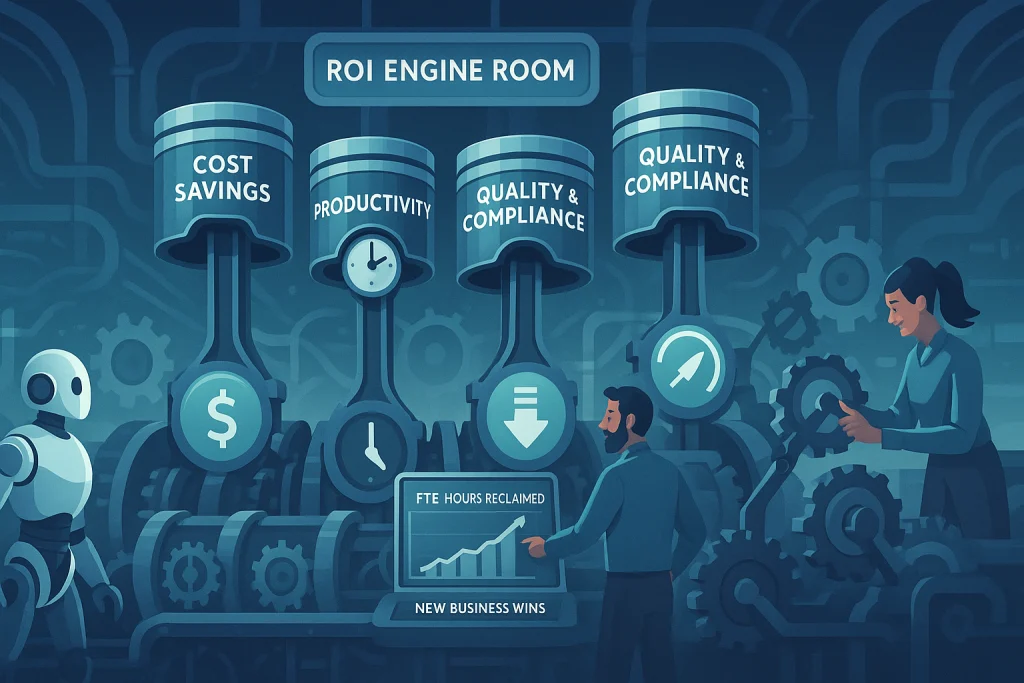
Factor 1: How do insurance BPO providers reduce costs?
Calculate labor cost reduction:
- The current internal labor cost in salary, benefits, and overhead for the outsourced positions
- Minus: outsourced labor costs at (fully-loaded insurance BPO provider cost, including setup and transition)
- Minus: Vendor management cost (staff to monitor vendor and ensure SLAs are met)
Usual benchmarks are USD 30,000-70,000 for each FTE replaced and a payback period of 12-18 months.
Factor 2: How to measure performance when working with a BPO provider? Productivity Gains
Measure workflow improvements:
- Reduction in processing days for renewing policies
- Increase new business bind ratio (speedier quotes lead to higher close rates)
- Claims processing cycle time (from FNOL to settlement acceleration)
- Internal team redeployment (FTEs freed from routine tasks redirected to sales, underwriting, client service)
Partnering with an insurance BPO provider can help achieve savings that commonly include a 20-30% cycle time drop, making 1-2 FTE hours each day available to generate revenue.
Factor 3: Quality & Compliance Improvements
Track error reduction and risk mitigation:
- Accuracy statistics (policy errors, missing endorsements, errors in COIs)
- E&O risk reduction (compliance audit findings; regulatory fines avoided)
- Customers are satisfied based on NPS scores, renewal retention rates, and complaint reduction.
Benchmark: Decline in compliance errors from fifty to seventy percent; rise in renewal retention from two to five percent.
How Assuretrac, an insurance BPO provider, measures this: Monthly dashboards include accuracy rates (target 99.5%), breakdown of error types, root causes, and solutions. Many agencies have a 60% reduction in E&O within six months of implementation.
Factor 4: Scalability & Business Agility
Measure flexibility gains:
- Ability to meet peak season demand without hiring temporary workers
- Time to launch new product line or expansion.
- Disaster recovery capability (i.e. geographic redundancy if vendor is in multiple locations)
Typical benchmark practice: provide 25-40% more capacity during peak season, without proportional increase in cost.
FAQs about Insurance BPO Service Providers
Q: Who are the leading insurance BPO providers?
A: The top insurance BPO providers include major global firms and specialized vendors like Assuretrac. The “best” depends on your agency’s specific needs, such as scale, specialization in certain insurance lines, technology integration capabilities, and whether you need insurance BPO providers USA based or offshore.
Q: What services do insurance BPO providers offer?
A: An insurance BPO vendor is a third-party organization that uses technology and specialized teams to ease an agency’s operations. Insurance BPO companies offer a wide range of insurance back office providers services, such as policy administration (renewals, endorsements), insurance claims processing providers support, underwriting assistance, customer service, and data management, improving efficiency, minimizing compliance errors, and reducing overall operational costs for the agency.
Q: How long does insurance BPO implementation take?
A: A standard implementation can take anywhere from 20-24 weeks across vendor assessment, process discovery, integration, a pilot and production, although some vendors, such as Assuretrac, suggest a 5-7 business day onboarding period for new partners.
Q: Which certifications should an insurance BPO provider have?
A: Check for third-party audits, including SOC 2 Type II regarding security, ISO 27001 regarding information security, HIPAA regarding health insurance portability, and GDPR regarding protection of EU data. A good insurance BPO service providers list will often note these certifications.
Q: What’s the difference between seat-based and outcome-based pricing?
A. Seat pricing charges a fixed monthly fee for example between $600 and $1200 each month or for each seat each month no matter how much time one works. In outcome-based pricing, pricing is applied per transaction (e.g. between $10 and $25 per renewal), with vendor incentives increasing linearly according to your efficiency over a fixed number of transactions.
Q: Which AMS platforms should providers support?
A: Verify the vendor works with major AMS vendors like Applied Epic, AMS360, Vertafore, EZLynx, or Hawksoft, and that the vendor is certified and tested. Insurance business process outsourcing providers should have deep expertise here.
Q: Can insurance BPO providers handle both routine and complex workflows?
A: Yes, most hybrids like this automate high-frequency, low-complexity tasks like renewing, but have expert humans on hand to handle exceptions like appealing or quoting multi-lines. It’s all about balancing cost and service, a key benefit of insurance bpo outsourcing.
Q: Which countries have the best insurance BPO providers?
A: Countries like the Philippines and India have long been leaders in the BPO industry due to cost advantages and large, English-speaking workforces. However, the “best” country depends on specific needs. For agencies prioritizing proximity and minimal time zone differences, top insurance BPO providers USA are a better fit, with hubs in cities like Dallas and Chicago.
Q: Which insurance BPO providers operate in the USA?
A: Many global and domestic insurance BPO vendors operate in the USA. Assuretrac is one such example, and there are many others with operational centers across the country, including in cities like Miami and Los Angeles, offering onshore support for agencies that require it.
Q: Do insurance BPO providers support small agencies?
A: Yes, many insurance outsourcing providers offer scalable solutions that cater specifically to small agencies. Models like outcome-based pricing or hybrid services are particularly beneficial, as they allow smaller firms to access expertise without the high overhead of full-time staffing.
Q: What questions should I ask an insurance BPO provider?
A: Key questions include asking about their insurance industry specialization, technology integration capabilities (especially with your AMS), pricing models and hidden costs, security certifications (SOC 2, ISO 27001), and for specific, measurable case studies with client references.
Q: What are the benefits of working with an insurance BPO provider?
A: The main benefits include significant cost savings on labor, improved operational efficiency through automation, reduced compliance and E&O errors, better scalability to handle fluctuating workloads, and the ability to free up your internal team to focus on high-value activities like sales and client relationships.
Q: Are there risks in working with BPO providers?
A: Yes, risks can include data security breaches, poor performance if SLAs are not met, lack of control over processes, and business disruption if the provider fails. These risks can be mitigated by choosing a reputable partner, having strong contracts with clear exit clauses, and verifying their security and compliance credentials.
Conclusion: Making the Insurance BPO Decision

Selecting an insurance BPO provider means selecting a partner. This partner helps you remain efficient. This partner helps you remain compliant. This partner helps you remain customer-centered.
The six evaluation criteria for choosing an insurance Business Process Outsourcing provider include specialization, technology, pricing, risk management, certifications, and case studies. These criteria help in evaluating an insurance BPO provider that meets the needs of the organization. A five-step adoption plan can help in the successful implementation of the BPO partnership. A 4-factor model of cost, productivity, quality, and scalability can be used to calculate the return on investment of outsourcing.
The insurance BPO market is changing rapidly. The best players offer strong insurance domain knowledge, automation, transparency of costs, and accountability. Your goal is to find that partner, negotiate good terms, and execute a disciplined implementation that delivers clear business value. To find out how Assuretrac can be that partner for your business, contact us today to start the conversation.