
ACORD 130 Workers Compensation Application: Complete Guide for Agents & Employers
Acord 130
The ACORD 130 Workers Compensation Application is a form that many insurance companies in the United States use to apply for workers compensation coverage. This form was created by an organization called ACORD, which stands for the Association for Cooperative Operations Research and Development. This form gathers all the information an underwriter needs. Including payroll, job classifications, loss history and details about business operations. In one document.
Before ACORD introduced this form each insurance company used its own version. Before this form existed agents had to fill out the information again and again for each different insurance carrier they worked with. The ACORD 130 Workers Compensation Application changed that. This makes the quoting process faster. Helps avoid errors caused by repeating the same data. Getting the information on this form matters because it directly impacts how premiums are calculated and whether coverage is approved.
Workers’ compensation insurance is required by law in every state for businesses that have employees. The ACORD 130 is the step in getting that coverage. Without it no carrier can properly assess risk. Issue a policy.
Table of Contents
Who Uses the ACORD 130 Workers Compensation Application?
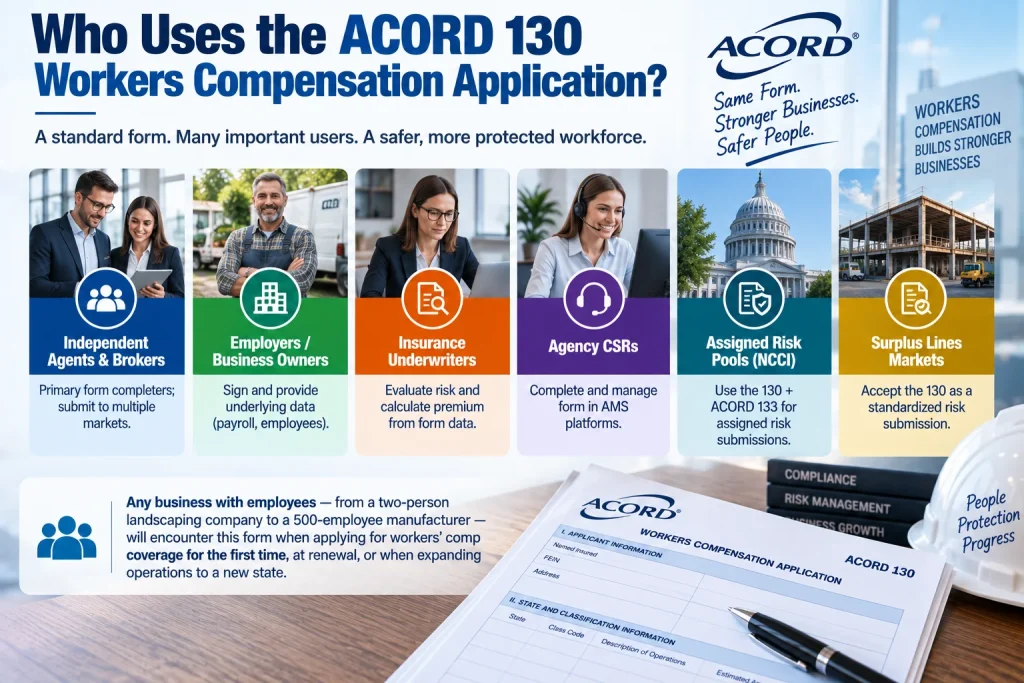
- Independent Agents & BrokersPrimary form completers; submit to multiple markets
- Employers / Business OwnersSign and provide underlying data (payroll, employees)
- Insurance UnderwritersEvaluate risk and calculate premium from form data
- Agency CSRsComplete and manage form in AMS platforms
- Assigned Risk Pools (NCCI)Use the 130 + ACORD 133 for assigned risk submissions
- Surplus Lines MarketsAccept the 130 as a standardized risk submission
Any business with employees — from a two-person landscaping company to a 500-employee manufacturer — will encounter this form when applying for workers’ comp coverage for the first time, at renewal, or when expanding operations to a new state.
How Does the ACORD 130 Workers Compensation Application Work? Step-by-Step
- Agency & applicant information. The agent enters their agency details and the business’s legal name, FEIN, address, and entity type. Many agency management systems (AMS) auto-populate this section.
- Status of submission. Indicate whether this is a Quote, Bound policy, or Assigned Risk submission. If it’s assigned risk, the ACORD 133 must be attached.
- Policy information. Record the proposed effective and expiration dates, the states requiring coverage, and any employer’s liability limits requested.
- Locations. List every work location. Each address is tied to its own risk profile and affects how underwriters assess exposure.
- Rating information. This is the core section. Enter each NCCI class code alongside the estimated annual payroll for that class. This directly determines the base premium.
- Experience modification (EMR). Include the current experience mod if applicable. A mod above 1.0 means the employer has had more losses than average; below 1.0 means fewer. It significantly adjusts premium.
- Operations description. This part asks the business to explain what it does in language. Underwriters use this to make sure the job classifications match the work being done.
- Loss history. Provide five years of prior workers’ comp loss runs — carrier, annual premium, number of claims, amounts paid, and open reserves.
- Yes/No underwriting questions. There are also 24 yes or no questions that cover topics like safety programs, use of subcontractors past policy cancellations and any unpaid premiums. These responses help underwriters understand risk exposure.
- Signatures. Both the employer and the insurance agent must sign the form before submitting it. That’s a requirement.
What Information Is Required to Complete the ACORD 130 Workers Compensation Application?
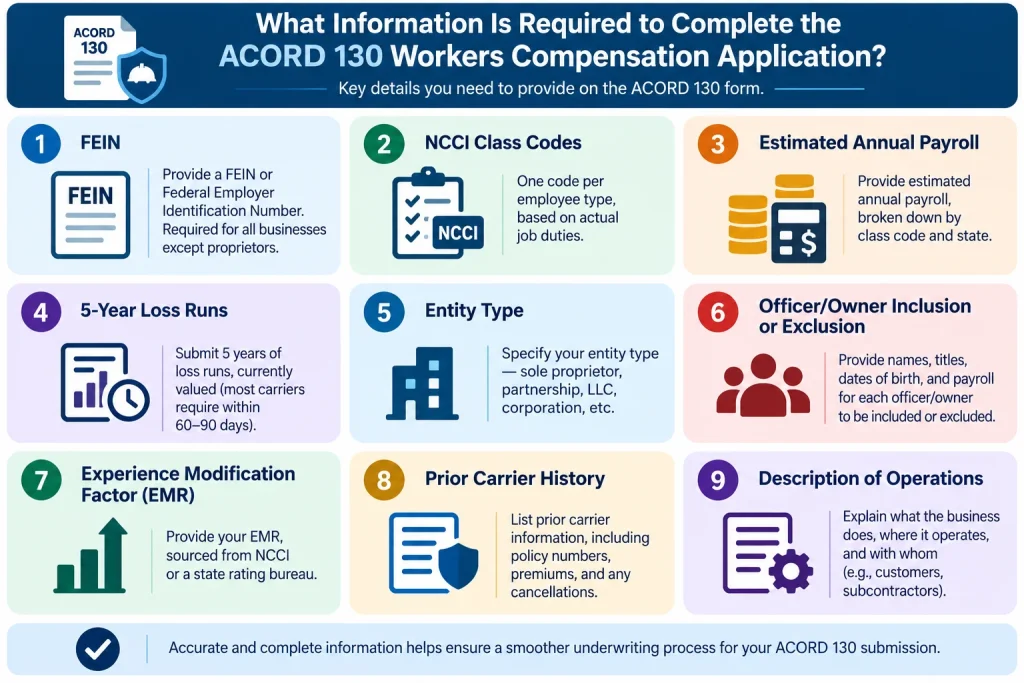
- FEIN — You also need to provide a FEIN or Federal Employer Identification Number. This is required for all businesses except proprietors.
- NCCI class codes — one code per employee type, based on actual job duties
- Estimated annual payroll — broken down by class code and state
- 5-year loss runs — currently valued (most carriers require within 60–90 days)
- Entity type — sole proprietor, partnership, LLC, corporation, etc.
- Officer/owner inclusion or exclusion — names, titles, dates of birth, and payroll for each
- Experience modification factor — sourced from NCCI or a state rating bureau
- Prior carrier history — policy numbers, premiums, and any cancellations
- Description of operations — what the business does, where, and with whom
ACORD 130 Workers Compensation Application vs. Related Forms
| Form | Name | Purpose | When Used With ACORD 130 |
|---|---|---|---|
| ACORD 125 | Commercial Insurance Application | Base business info for all commercial lines | Often submitted together; 130 supplements it for WC-specific data |
| ACORD 133 | Workers Comp Assigned Risk Section | Required supplement for assigned risk (residual market) submissions | Attached when the insured cannot obtain voluntary market coverage |
| ACORD 101 | Additional Remarks Schedule | Extra space for explanations | Attached when any “yes” answers need detailed explanation |
Common Mistakes on the ACORD 130 Workers Compensation Application
Using an outdated form version
ACORD updates its forms often. If you submit a version of the ACORD 130 Workers Compensation Application it might get rejected or marked as NIGO. Not In Good Order. To avoid problems always download the version from ACORD or your insurance management system.
Mismatching class codes to actual job duties
Class codes must reflect what employees actually do, not what sounds closest. A clerical worker coded as a roofer will trigger an audit correction — and potentially an E&O claim. Reference the NCCI Scopes Manual when in doubt.
Underestimating payroll
Low payroll estimates reduce the deposit premium — but the final premium is set at audit. A significant underestimate leads to large audit bills and dissatisfied clients. Use realistic projections based on current payroll records.
Submitting without current loss runs
Most underwriters require loss runs valued within the last 60–90 days. Submitting without them typically delays quoting or results in conditional indications only. Request updated loss runs before starting the application.
Missing officer inclusion/exclusion data
Failing to list all officers and partners — including their payroll and whether they are included or excluded from coverage — is one of the most common sources of underwriting questions and policy errors.
Frequently Asked Questions (FAQ)
What is the ACORD 130 Workers Compensation Application used for?
The ACORD 130 is the standardized Workers Compensation Application used to apply for workers’ comp insurance. It collects business details, payroll by class code, loss history, and operational information that insurers need to quote and issue a policy. Every workers’ compensation policy submission begins with this form.
Do I need to submit the ACORD 130 Workers Compensation Application at every renewal?
Not always — many carriers renew existing policies with updated loss run and payroll data rather than requiring a full new application. However, if there are significant changes in operations, ownership, payroll, or states of coverage, a new or updated ACORD 130 is typically required.
What’s the difference between the ACORD 130 Workers Compensation Application and ACORD 125?
The ACORD 125 is a form. It’s used for commercial insurance and collects basic business information. The ACORD 130 is more detailed and built for workers’ compensation. It includes fields like NCCI class codes, payroll by job category experience modifiers and loss runs. Things the 125 does not have.
What happens if payroll is estimated incorrectly on the ACORD 130 Workers Compensation Application?
The estimated payroll sets the deposit premium, but the final premium is determined at a policy audit. If actual payroll is higher than estimated, the business owes additional premium. If lower, it receives a refund. Significant underestimates can result in large audit bills, client disputes, and potential errors & omissions exposure for the agent.
Can I submit the ACORD 130 Workers Compensation Application without current loss runs?
In most cases, no. Underwriters typically require currently valued loss runs — often within 60 to 90 days — before issuing firm quotes. Submitting without them may result in a NIGO (Not In Good Order) rejection or a conditional indication only. Always request updated loss runs from the prior carrier before completing the submission.