
ACORD 130: What It Is and How to Complete the Workers’ Compensation Application
Acord 130
If you’re submitting a workers’ compensation quote or renewal, the ACORD 130 is the form that makes it happen. Whether you’re an agent preparing a submission or a business owner wondering what your broker is asking for, understanding this form saves time and helps you avoid the dreaded “not in good order” callback.
This guide covers what the ACORD 130 includes, how to complete it correctly, and how to avoid common mistakes that delay underwriting.
ACORD 130 is the standard workers’ compensation application form used across the U.S. insurance industry. It collects payroll by classification code, loss history, business locations, and other details carriers need to price and bind coverage. Unlike other commercial lines, a workers’ comp submission can go out on the ACORD 130 alone, no ACORD 125 base application is required.
Table of Contents
What Is the ACORD 130 Form?
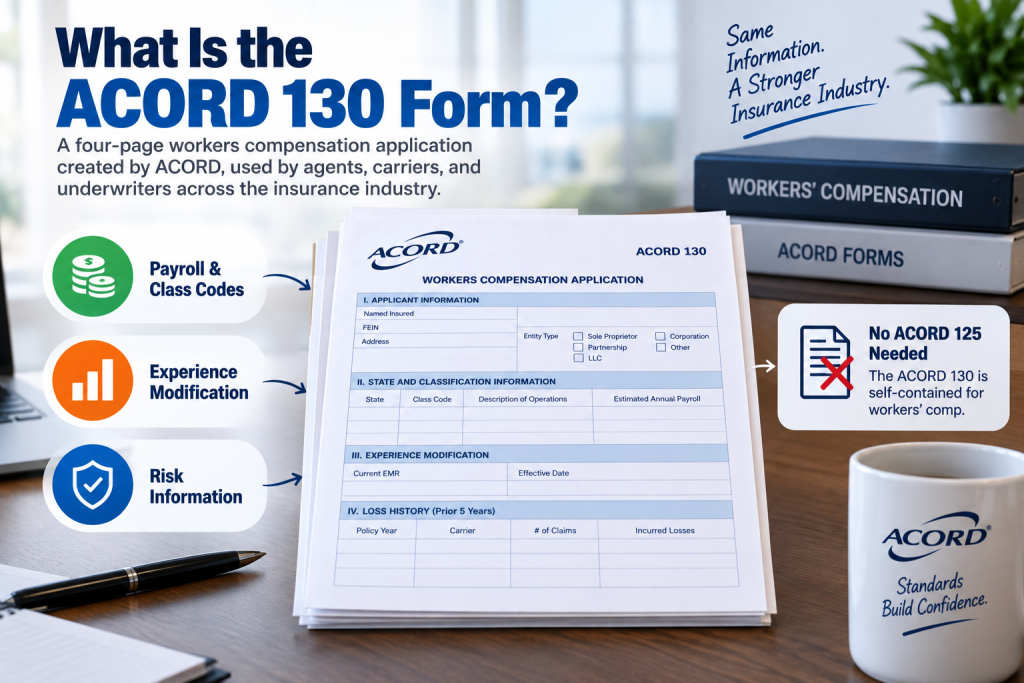
The ACORD 130 is a four-page workers compensation application created by ACORD the nonprofit standards body that develops forms for the insurance industry. It ensures agents, carriers and underwriters all work from the data points.
Every section feeds directly into underwriting. Payroll and classification codes determine the base premium. The experience modification factor adjusts that premium based on claims history. And the general information questions covering subcontractors, safety programs, and more shape how the underwriter views overall risk.
One key distinction: the ACORD 130 is self-contained. For other commercial lines, agents start with the ACORD 125 and attach a supplement. Workers’ comp is different the ACORD 130 carries its own applicant information, locations, and business description, so a monoline WC submission needs only this form.
Key Sections of the ACORD 130
The form is organized into sections and each one matters for different reasons.
Applicant Information captures the business name, FEIN (Federal Employer Identification Number) entity type and contact details. The FEIN must match official tax records exactly even a transposed digit causes system mismatches. The entity type (corporation, LLC, partnership, sole proprietor) also affects whether owners and officers are included or excluded from coverage.
Locations and States of Operation requires physical street addresses for every work location no PO boxes. Multi-state businesses must list each state so the carrier rates exposures by jurisdiction.
Rating Information is the core of the form. It captures payroll by classification code, employee counts, and the experience modification rate (EMR). The experience mod is a multiplier assigned by a rating bureau. NCCI (the National Council on Compensation Insurance). Based on actual versus expected losses. Below 1.0 lowers the premium; above 1.0 increases it. Omitting the mod worksheet means the carrier quotes at manual rates, usually higher.
Loss History covers the previous five years of claims. Attach currently valued loss runs most underwriters want them dated within 60 to 90 days. If there are no claims, note that explicitly. A blank loss history section raises questions; “no known losses” does not.
General Information Questions include roughly 24 yes-or-no items about safety, subcontractors, hazardous materials, and employee travel. Any “yes” requires a written explanation in the remarks. Skipping questions or leaving “yes” answers unexplained is a top reason underwriters return forms.
How Does ACORD 130 Work with Other ACORD Forms?
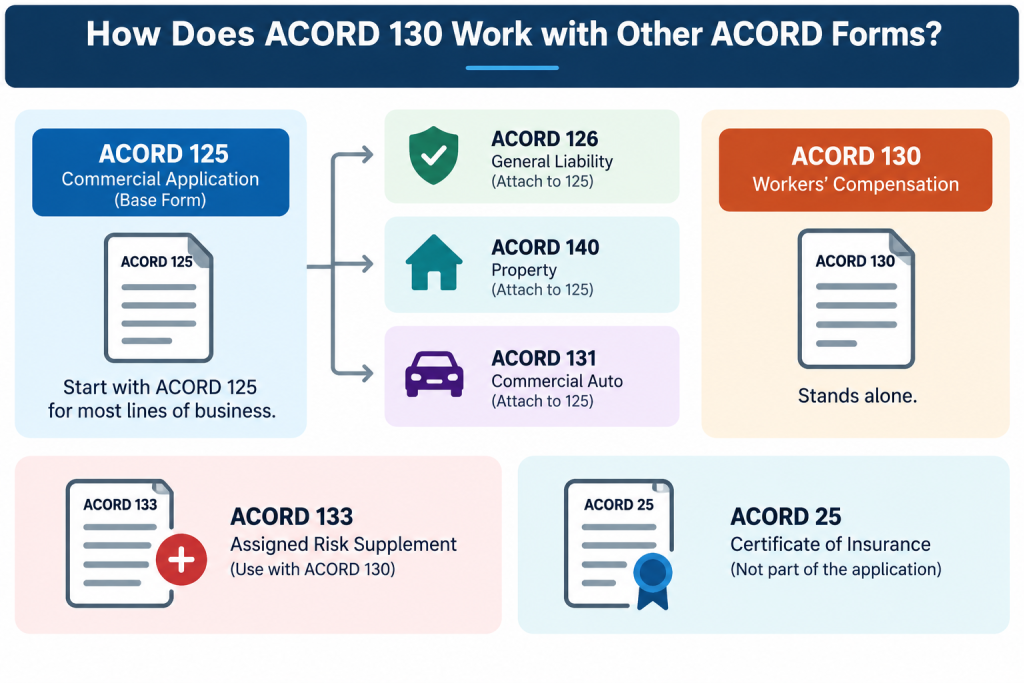
The ACORD 125 is the base commercial application. For general liability (ACORD 126), property (ACORD 140), and commercial auto (ACORD 131), you start with the 125 and attach a supplement. Workers’ comp breaks that pattern the ACORD 130 stands alone.
The ACORD 133 is the Workers’ Compensation Assigned Risk Supplement. When a business cannot get coverage through the voluntary market and applies through the residual market (assigned risk plan), the ACORD 133 must accompany the ACORD 130. NCCI requires that assigned risk applications include complete classification, payroll, and location data for every listed state, plus signatures from both the agent and an authorized business representative.
The ACORD 25 is a Certificate of Insurance it proves existing coverage and has nothing to do with the application process.
When Do You Need a State-Specific Version?
Most states accept the ACORD 130 but Florida requires the ACORD 130-FL and California requires the ACORD 130-CA (updated in 2023). Using the wrong version results in a rejected submission. If you’re unsure which applies, check with the state workers’ compensation bureau or your carrier.
Common Mistakes That Cause NIGO Rejections
NIGO “Not In Good Order” is the industry shorthand for an incomplete or incorrect submission that gets sent back for corrections. These are the errors that come up most often on ACCORD 130 submissions:
- Missing or incorrect FEIN. A transposed digit or outdated number stalls the submission immediately.
- Understated payroll. Reporting lower payroll reduces the initial premium, but the carrier catches the difference at audit resulting in a large retroactive bill and potential E&O exposure.
- Blank or partial yes/no answers. Every general information question needs a response. A “yes” without an explanation is treated the same as a blank.
- Outdated or missing loss runs. Loss runs older than 90 days are among the most frequent callback reasons.
- PO boxes instead of physical addresses. Location addresses must be street addresses, especially for multi-state rating.
- Wrong form version. Submitting the standard ACORD 130 for a Florida or California risk instead of the state-specific edition will be returned.
Tips for a Cleaner Submission
Before starting the form gather your documents. Having the FEIN current payroll reports, classification codes, experience mod worksheet and recent loss runs ready before you begin saves time. Reduces inconsistencies.
Treat the form as a communication tool. Each field answers a question underwriters are already asking. Be specific enough in the business description that an underwriter unfamiliar with the account can understand the operations.
If your agency uses a management system like AMS360, much of the applicant data can auto-populate from existing records. For assigned risk submissions, confirm the ACORD 133 is attached and that an owner or officer has signed both forms.
Frequently Asked Questions
Can you submit ACORD 130 without an ACORD 125?
Yes. The ACORD 130 is self-contained with its sections for applicant information, locations and operations. For a monoline workers comp submission it is the application form required. The ACORD 125 is needed when bundling workers comp with other commercial lines in a package.
Who is authorized to sign the ACORD 130?
An owner, partner, or corporate officer of the applicant business must sign the ACORD 130. The agent or broker also signs in a separate section. For assigned risk submissions, both the ACORD 130 and ACORD 133 require signatures. An unsigned form will not be processed regardless of how complete the data is.
What happens if payroll is reported incorrectly on the ACORD 130?
Estimated payroll determines the deposit premium at the start of the policy. The final premium is set during a payroll audit at the end of the policy period. If payroll was significantly understated the business receives an audit bill for the difference. Overstating means paying upfront, than necessary.
Does every state use the same ACORD 130?
Most states accept the standard ACORD 130. Florida and California are exceptions they require the ACORD 130-FL and ACORD 130-CA respectively. Submitting the wrong edition typically results in rejection. Check with your carrier or state bureau if you operate in a state with unique workers’ comp rules.
What is the ACORD 133, and when is it needed?
The ACORD 133 is the Workers’ Compensation Assigned Risk Plan supplement. It is required when a business cannot get coverage through the voluntary market and applies through the residual market. The ACORD 133 accompanies the ACORD 130 and collects additional data that NCCI and state plans require for assigned risk underwriting.