
ACORD Workers Compensation Forms: Everything Agents & Employers Need to Know
Acord Workers Compensation
ACORD workers compensation forms are the documents used by businesses across the United States to apply for get and keep workers comp coverage. ACORD. The Association for Cooperative Operations Research and Development. Developed these forms to replace the hundreds of formats that insurance companies used before. Now there is a shared way for everyone. Agents, underwriters, insurers and regulators. To understand and work with the information.
Workers comp insurance is required by law in every U.S. State for employers who have employees. The ACORD forms are how that legal requirement is met. These forms collect details about a business: how it operates how much it pays in payroll and the risks it faces. Underwriters use this data to decide if a business should be insured and at what cost.
ACORD processes than 300 million standardized documents every year in the U.S. Insurance industry. This standardization saves the industry billions of dollars each year in costs. It also cuts down on mistakes and speeds up processing.
Table of Contents
Who Uses ACORD Workers Compensation Forms?
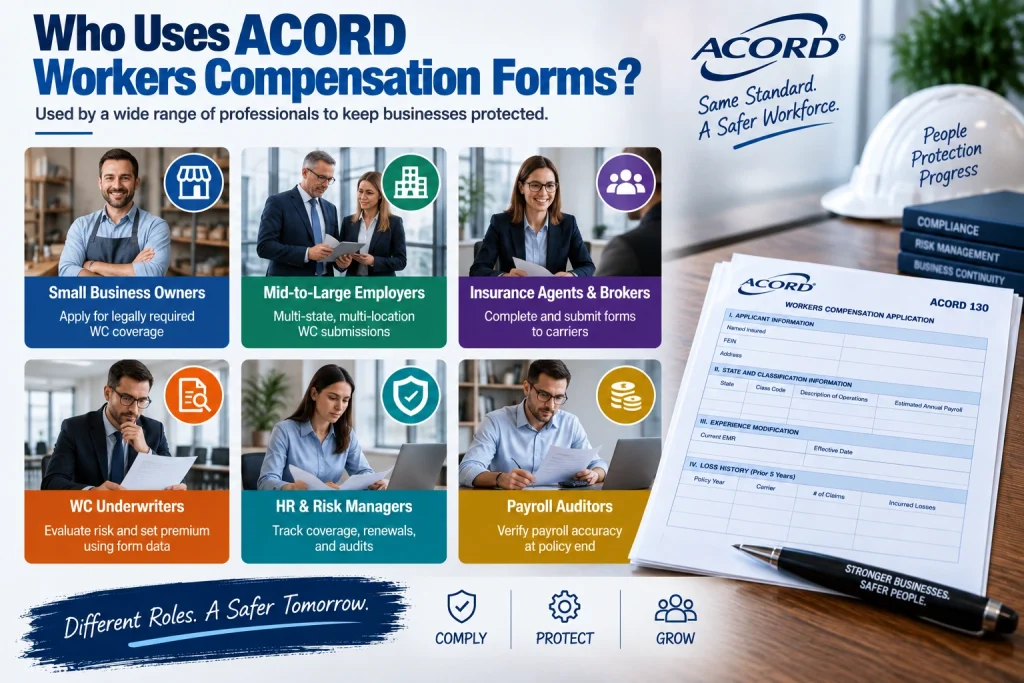
- Small Business OwnersApply for legally required WC coverage
- Mid-to-Large EmployersMulti-state, multi-location WC submissions
- Insurance Agents & BrokersComplete and submit forms to carriers
- WC UnderwritersEvaluate risk and set premium using form data
- HR & Risk ManagersTrack coverage, renewals, and audits
- Payroll AuditorsVerify payroll accuracy at policy end
How Do ACORD Workers Compensation Forms Work?
ACORD workers compensation forms work together as a system. Here’s how they fit into the full workers’ comp policy lifecycle:
- Quote phase. The agent completes the ACORD 130 (Workers Compensation Application). It captures the business’s payroll by NCCI class code, operations description, officer information, and five years of loss history. This data is submitted to one or multiple carriers to obtain quotes.
- Bind phase. The insured selects a carrier. The ACORD 130 is updated to reflect “Bound” status. If the insured could not obtain voluntary coverage, the ACORD 133 is attached and both forms are submitted to NCCI’s assigned risk program via RMAPS.
- Policy issuance. The carrier uses the ACORD 130 data — especially class codes and payroll — to calculate the deposit premium. This is an estimate. The true premium is determined later at audit.
- Mid-term changes. New locations, ownership changes, or significant payroll shifts may require an updated ACORD 130 submission during the policy term.
- Audit phase. At policy end, the carrier audits actual payroll against estimated payroll reported on the ACORD 130. If actual payroll was higher, the employer owes additional premium. If lower, a refund is issued.
- Renewal. When a business renews its workers comp coverage carriers often ask for a new ACORD 130. This is especially true if the business has changed its operations added employees or if its payroll or claim history has changed significantly.
What Information Is Required on ACORD Workers Compensation Forms?
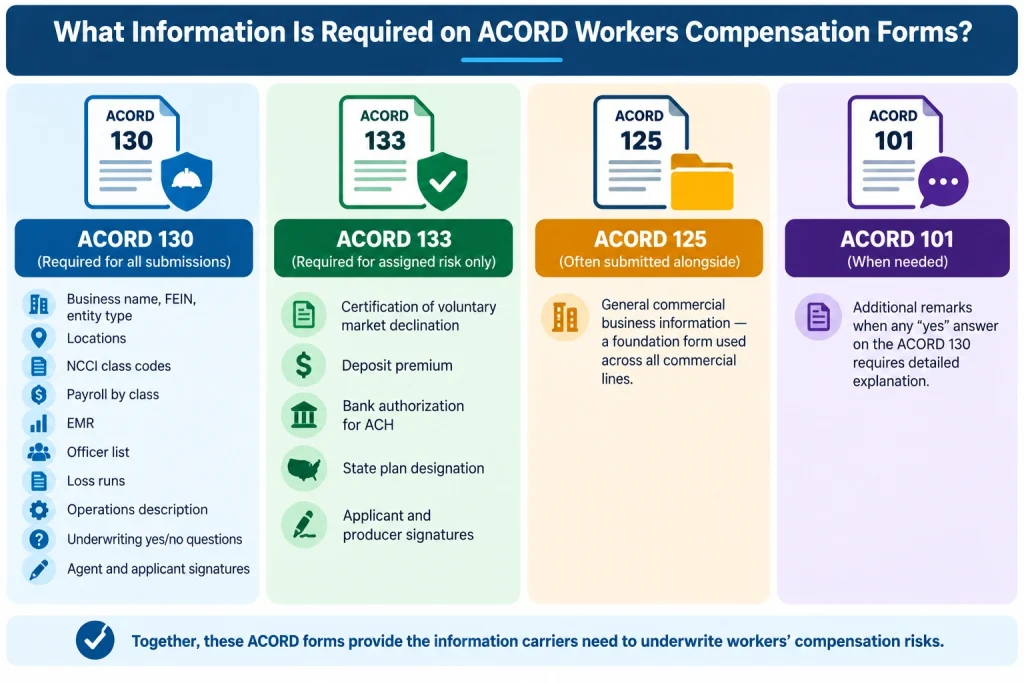
- ACORD 130 (required for all submissions): Business name, FEIN, entity type, locations, NCCI class codes, payroll by class, EMR, officer list, loss runs, operations description, underwriting yes/no questions, agent and applicant signatures
- ACORD 133 (required for assigned risk only): Certification of voluntary market declination, deposit premium, bank authorization for ACH, state plan designation, applicant and producer signatures
- ACORD 125 (often submitted alongside): General commercial business information — a foundation form used across all commercial lines
- ACORD 101 (when needed): Additional remarks when any “yes” answer on the ACORD 130 requires detailed explanation
ACORD Workers Compensation vs. State-Specific WC Forms
| Factor | ACORD Forms | State-Specific WC Forms |
|---|---|---|
| Acceptance | Accepted by 95%+ of carriers nationwide | Required only in specific states (FL, WI for assigned risk) |
| Standardization | Universal across carriers and states | Designed for state-specific rules or programs |
| Scope | Covers all commercial WC submissions | Supplements or replaces ACORD forms in certain jurisdictions |
| Examples | ACORD 130, 133, 125 | ACORD 130 FL, Wisconsin WCRB Pool App |
Common Mistakes With ACORD Workers Compensation Forms
Treating the ACORD 130 as a formality rather than a risk document
Every single field on the ACORD 130 affects underwriting decisions. If you rush through it or skip sections you open the door to follow-up questions, delays and less favorable coverage terms. This form should be treated as the important document in the entire application process.
Not coordinating ACORD 130 and 133 data
When both forms are submitted together, inconsistencies between them — different business names, different payroll figures, mismatched dates — cause processing delays or NIGO designations. Verify that both forms align before submitting.
Ignoring the experience modification factor
The EMR can raise or lower premium by 20–50% or more. Agents who don’t verify the current mod — and who don’t help clients understand what drives it — miss an opportunity to save clients money and improve retention.
Submitting loss runs that aren’t currently valued
Carriers want loss runs valued within 60–90 days. Old or stale loss runs create uncertainty and often result in the submission being delayed or declined until current runs are provided.
Failing to update forms when operations change
A company that starts a service line hires workers in a new state or changes ownership without updating its ACORD forms risks a gap in coverage. It might also end up paying the premium. Both problems can lead to loss and legal liability. For the employer and the agent.
Frequently Asked Questions
What ACORD forms are used for workers’ compensation?
The main ACORD forms used for workers comp are:
ACORD 130 – Workers Compensation Application (required)
ACORD 133 – Workers Compensation Insurance Plan Assigned Risk Section (for risk or non-standard cases)
ACORD 125 – Commercial Insurance Application (often used with the 130 as a base form)
ACORD 101 – Used when extra space is needed for explanations or details
Is ACORD workers compensation the same as state-mandated coverage?
ACORD forms are not the insurance itself. Workers comp insurance is a requirement, in each state. The ACORD forms are the tool used by agents and employers to apply for that required coverage. Through private insurers or state-run programs.
How do ACORD workers compensation forms affect my premium?
The data reported on the ACORD 130 — specifically your payroll by class code, experience modification factor, and loss history — directly determines your premium. Accurate payroll and correct class codes result in a fair premium; inaccurate data leads to either overpaying upfront or facing a large audit bill at policy end.
What’s the difference between voluntary and assigned risk workers’ comp?
Voluntary market means standard insurance carriers are willing to insure the business at competitive rates. Assigned risk (or residual market) means the business could not obtain voluntary coverage and is placed in a state-administered pool — typically at higher rates. The ACORD 133 is only needed for assigned risk submissions.
Can I use ACORD workers compensation forms in every state?
The standard ACORD 130 is accepted in most states. However, a few states — most notably Florida and certain state-specific assigned risk plans — require their own version of the application. Always verify whether your target state requires the standard ACORD form or a state-specific equivalent before submitting.